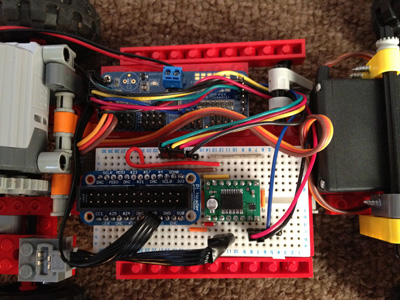
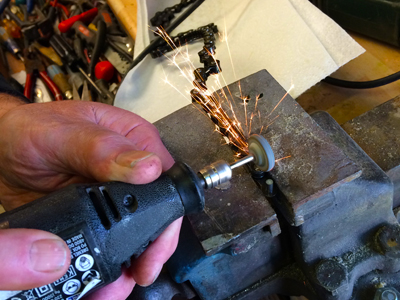
Lego/Raspberry Pi Project, a set on Flickr.
I kept a photo diary during the construction of the Lego/Xbox/Raspberry Pi project.
Lego/Raspberry Pi Project, a set on Flickr.
I kept a photo diary during the construction of the Lego/Xbox/Raspberry Pi project.When I was a child I always wanted a remote control car. I never got one — usually my parents convinced me that the novelty would wear off in an hour, and that it wouldn’t be worth the expense. (They were probably right). I usually opted for a safer videogame-based option at Christmas time, and on my birthday I’d ask for Lego.

The Raspberry Pi — a tiny, low-power computer that fits in the palm of your hand — provided the inspiration for a project to finally put that right. Using bricks from my childhood Lego collection, and a wireless Xbox 360 controller from my teenage years, at long last I could hack together a remote control car! How hard could it be?
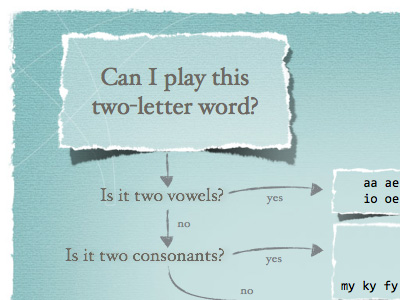
For the lazy: Not interested in all this data wrangling? Skip straight to these summary graphics to improve your Scrabble game:
A while ago I was blogging about a little research project I called Hacking Scrabble, which received a lot of interest and was published on LifeHacker. I was trying to get better at the game by using the kind of memory tricks we learned in school:
“My Very Easy Method Just Speeds Up Naming Planets”
I’m a programmer by trade so inevitably I wrote Mnemonic Finder, a Python program to quickly search the dictionary looking for these kinds of phrases. The idea was to memorise all two-letter words, which I’m targeting because:
The International version of the Scrabble memory technique I have been researching. (Valid everywhere except the US, Canada and Thailand).
Source data here: https://gist.github.com/3141231
The US version of the Scrabble memory technique I have been researching. (Valid in the US, Canada and Thailand).
Source data here: https://gist.github.com/3141380
Edit: See this article for the final result of this project!
This post isn’t really about Scrabble. It’s about taking a load of ugly data and hacking around with some scripts to refine it into something I can commit to memory. Then its about Scrabble. Winning at Scrabble.
Knowing exactly which two-letter words exist gives a player a sizeable advantage because it opens up tight corners of the game board and allows them to run two words side-by-side. Sadly most of us only know a handful, and beyond that we’re guessing. Then we’re arguing. And then (inevitably) looking on Google for a list of valid words.
Personally I’m all for having the 2-letter-word-list on display during play to help us out of tight spots and to keep things fair. But I’ve had plenty of opponents object to this, saying that if I really want to play like that I should memorize the list. How hard can it be?